 Further conversation with Michael Downing, author of Breakfast with Scot, the first book being discussed in the Seattle Gay & Lesbian Book Club. To read Part 1, click here.Brad Craft
: Religion is at the center of some of your earlier books, but not so much Breakfast with Scot.
Michael Downing: I’m very bad at religion. I gave it up when I realized my practice was a fantastically complicated method of wishing it weren’t so.
I’m not unaware that one of the few tenets common to religions around the world is the illegitimacy of GLBT people—in fact, it seems to the one of the criteria for ascending into the ranks of the so-called Great Religions of the World. It also helps to have a lot of preposterous advice for women. And I know this has made for a lot of misery. But I wanted to get at something that resides well below the level of stupidity and hate and codified bigotry.
I nixed religion in the neighborhood for two reasons. First, I could. Second, I wanted to place Sam and Ed and Scot in a benign world—a world in which more people than not are trying to get it right. (Cambridge really seems like such a place to me.) I’d read a lot of novels about gay people whose identities were formed in opposition to the culture. I got interested in what was at stake when gay people were embraced by the culture—what was at stake for gay people and for the culture.
BC: Our Book Club host,
Nick DiMartino is, to use his own word, "obsessed" with first-person narrators.
MD: I share Nick's obsession.
BC: Your earlier novel, Perfect Agreement and Breakfast with Scot both have narrators who seem to share, for want of a better term, a gay sensibility; bemused, ironic, self-consciously, almost preemptively, self critical.
MD: I love the phrase
preemptive self-criticism. It conjures up the cartoonish image of somebody constantly punching himself to beat everybody else to the punch. It's funny while it's happening -- and then you see the bruise.
BC: You've said elsewhere that you "wanted to write a genuinely comic novel about shame."
MD: In the most highfalutin terms. For what it's worth, I wanted to make the literal text of the novel transparent. This was in part a measure of how deeply I had fallen in love with the declarative sentence. And it was also something about my own sense that Scot -- all of us, I guess -- was first and foremost a kid, not a cryptogram or a problem to be solved. I figured if the literal text was plain, readers would be in the position all of the other characters -- especially Ed -- are in whenever they encounter Scot: staring at the obvious and turning it into a Rorschach test.
BC: And a first-person narrator, in this case Ed, puts the reader in Ed's position.
MD: The simple answer is that both Perfect Agreement and Breakfast with Scot are novels about community and the first-person narrator created a natural tension. Both Mark Sternum (
the narrator of Perfect Agreement) and Ed are reluctant to surrender their singular sense of themselves.
Also, I think I might feel most confident as a writer—maybe I mean, least self-conscious—when I am inhabiting a character who wants nothing more than to talk, talk, talk to the reader. Frankly, nothing makes me weak in the knees like a good conversation. My most rewarding and intimate relationships are fueled by conversation. After a dinner at our house on the first night of a long weekend with several long-time friends, a relative newcomer said he felt like he’d been shipped off to Camp Can’t Shut Up. That’s my idea of heaven: Camp Can’t Shut Up.
BC: Ed is also very funny. I was reminded of other funny first-person characters, like Bertie Wooster. Ed seems to me to have something of that same innocence when we first meet him...
MD: I am a devoted Wodehouse fan. I’d love to think something of him rubbed off on me besides the ink from all those Penguin paperbacks. And I think it is very generous of you to call Ed innocent. If you mean, Ed is one of those people who is constantly astonished that the rest of the world still is not behaving as he would prefer, I agree.
My sense is that the quality
all the characters (in Breakfast with Scot) share is almostness. Sam, as a chiropractor, is almost a doctor. Ed, as an editor at an arts magazine, is almost an artist. The neighbors, the Burlingtons are almost a family. Sam's brother Billy is almost Scot's father. Scot is almost a boy. And so on. You get it, I'm sure. The tragic (or more often in bad novels, melodramatic) version of this quality is a sense of fraudulence, of course. I liked the idea of almostness because it gives credit for people trying, for having ambitions and hopes, for taking a shot at something -- love, style, a neighbor's window -- even though they have bad aim. Unlike fraudulence, which is a lonely, unspeakable secret we carry, almostness is something others can do something about, should they be so inclined. Fraudulence gets solved (if it ever does) by the self. Almostness is susceptible to others, to the possibility that completeness is not a singular achievement.
BC: Nick and others have all asked about the movie made out of
Breakfast with Scot.
MD: I am so grateful they made it -- I mean both that it got made and that it got made by that particular creative team and not any of the previous people who'd optioned it and seemed not to understand that it was meant to be funny -- that I am a bad reporter. I know that the screenwriter and director and producer were very nervous about showing me the first draft of the screenplay because of the hockey business (
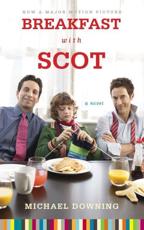
the character of Ed goes from being an arts magazine editor to being a former professional hockey player in the movie) -- which I really loved, oddly. It seems to me a genuine idea, and it also had the virtue of turning the project into an adaptation, not a film version of my novel. I love the cast. I wish we had more time with the women characters, each of whom struck me as spot on, as portrayed in the movie. I totally admire Noah Bernett, who plays Scot, and the choice to cast a kid who was not conventionally cute or elegant. I didn't love the choice to make him a great skater. I preferred the idea that Scot didn't come with any compensatory skills or adroitness often assigned to outcasts. And though I didn't love the choice to put Ed (renamed Eric in the film because Tom Cavanagh, who played him, was too identified with his TV show "Ed" -- really) in the closet, though I thought Cavanagh was superb, and I think he put on the screen something really new about what a man will do to himself and everyone around him not to feel what he is feeling.
BC: When are we going to get another novel from you?
MD:All I want to do is finish my memoir, I’ll Make it Up to You, and write a novel. I've been waylaid by the facts for way too long.
BC: Has being labeled a gay novelist limited you at all? Gay fiction seems to be disappearing as a bookstore genre.
MD: As for limits—well, I think the project of my life has been learning to love my limits. I really don’t think my career has ever been adversely affected by my being a gay man or by my choice to write about gay people. There have been three editions of Breakfast with Scot and my publisher is bringing out a new edition of Perfect Agreement at the end of this year. Frankly, the only thing holding me back is what I don’t do every day.
As for “gay fiction”—it occurs to me that genre is a lot like gender. I don’t trust the various categorical distinctions, and I really never think about them while I am writing. I mean, who feels confident about drawing the line between fiction and nonfiction these days?
 BC
BC: Thanks, Michael. We'll be checking in again I'm sure before we're done with Breakfast with Scot. Any last thoughts today?
MD: For now: David Geffen throws a million-dollar party for Barack Obama before anybody thinks Obama has a prayer of being elected and two years later Obama invites Rick Warren to say a prayer at his inauguration party—that’s a sublime gay novel just begging to be written.

 A new question from the Seattle Gay & Lesbian Book Club for our author Michael Downing, about his novel Breakfast with Scot. Nick & Co. wanted to know if Scot -- the little boy inherited by the central characters Ed and Sam -- was based "on a real boy." Herewith, Mr. Downing's response:
  slacks and dragging a boa. I had no idea who he was or what he wanted with me, but he'd just stand there is his slouchy, hands-on-the-hips way and stare, occasionally widening his eyes to convey his astonishment at my failure to introduce myself and get him a cold beverage.Maybe he was an amalgamation of boys whose flamboyant bravery I'd admired. Maybe I hauled him out of my fear that he was the boy people saw hiding inside of me. Whoever he was, he made it clear he wouldn't go away, no matter how often I raised my eyebrows or sighed audibly to let him know I was too busy to entertain visitors.







 Posts
Posts


