Local author Matthew Simmons was kind enough to agree to be bombarded with a variety of questions. Here is a concise version of the words that went flying back and forth.
Who are you, and what do you do? Why should I be asking you questions?
I’m Matthew. I work at the bookstore. I write copy for ads, signs, and newsletters.
You say you’re Matthew and you work at a bookstore, but isn’t it also true you’re a writer of fiction? Who is Matthew Simmons: local author?
Umm. I suppose I am a writer of fiction, too. Beyond that, who knows.
Zombie virus attacks the planet. Not only are the recently dead infected, but the classically dead as well. Both Ovid and Horace are in your apartment. Who do you take down first?
Horace. It would be hard to convince myself to take out the author of Metamorphoses.
Do you go to the zoo often? I think you live near there.
Not as often now that the Nocturnal House is gone. One of the first short stories I ever finished involved that place. I think I managed to spot all the animals—even the rabbit-y thing. (Can’t remember what it was called.)
I was very sad to hear of the passing of the Pallas’s Cat. I used to go to the zoo weekly and every time I would walk by the Pallas’s Cat enclosure, the animal would be hiding or asleep. One rainy Sunday, though, I walked by, leaned on the railing and up popped its head. And then it walked out into the open, stared in my direction for a couple of minutes, and left.
How long have you had your cat, Emmett?
Seven or eight years? He’s from a kill shelter in Everett. Got there in time. Of all the cats in the shelter, he was the least interested in my arrival. I thought, well this cat isn’t into me at all. I think I'll take him home.
Scientists and politicians are asking James Cameron for advice, so now it’s your turn: how would you plug the oil leak in the Gulf of Mexico?
There’s another writer named Matthew Simmons who is an oil industry guy. Apparently if you ask him, he’ll tell you to nuke the well closed.
Me, no clue.
Who is your favorite superhero and why?
Matter-Eater Lad. Because after his career as a superhero, he became a public servant, and served the planet Bismoll in some sort of planetary senate.
What was your experience like at Warren Wilson? A Jello Horse seems to be inspired, at least partially, by your time spent there. But which instructor would you say, generally speaking, influenced or inspired you the most?
My favorite advisor at Warren Wilson was Mike McNally. On his book covers, he goes by T.M. McNally. Fantastic writer, fantastic teacher.
I liked Warren Wilson. I have quipped that when I wrote A Jello Horse, I was doing all the things I was told not to do, but I’ve mostly been kidding about that. It’s not so much what I was told “can’t work in fiction,” as it was simply I was warned that there are significant tonal or structural effects of using, say, present tense or second person. Choices have consequences. And a writer needs to compensate for what is lost when a constraint is placed on a piece of writing.
What music, movies, or non-literary arts have influenced your writing the most?
Some of my earliest attempts at creating fiction were when I was in college and making music with my friends. I spent time creating an elaborate fake history for a “band” I started. I stole this idea from Negativland.
When you feel kind of lost in your work, what do you do? How do you find your way again?
Start something else, usually. Which is, I’ve come to realize, a terrible idea.
I understand you and Ryan Boudinot go way back. Where does the story of your friendship begin?
Ryan and I did a reading together a number of years ago. It was me, Ryan, and David Drury (a writer and musician—check out his band Tennis Pro). We were asked to do a Monkeybicycle reading, they,
because both had been in the very first Best Nonrequired Reading, me I think because they were desperate. My buddy Shya Scanlon set the reading up. Ryan and David were pretty amazing. I was embarrassed by my material and my performance (it was, I think, the second time I had read something I wrote in front of a crowd), and I left quickly without talking to anyone.
Ryan asked Shya how to contact me, and he and David were kind enough to include me in a three-person writer’s group. It was the first time I had been in such a thing. During that time, Ryan explained the MFA system to me and encouraged me to consider looking into low residency programs.
Ryan’s early encouragement—and continuing encouragement—has meant the world to me.
What books would you suggest someone read to be reminded of the transformative power of fiction? Or maybe just five books you view as essential? Books that you would feel naked without.
I can read the story “Strays” by Mark Richard over and over without ever getting tired of it. It’s in a really good collection called The Ice at the Bottom of the World. Same goes for “The Ceiling” by Kevin Brockmeier.
It took me years to finally get up the nerve to read Moby-Dick. It bothers me that no one ever even suggested to me that that book can be very funny.
The Third Policeman by Flann O’Brien? 60 Stories by Donald Barthelme? David Foster Wallace’s nonfiction or “The Suffering Channel”?
Here’s a book I love: You’re An Animal Viskovitz by Alessandro Boffa. Modern-day Ovid.
And Meet Me in the Moon Room by Ray Vukcevich. I love that book so very much.
***
Matthew Simmons is the author of the novella A Jello Horse, contributor to The Pacific Northwest Reader and Best of the Web 2010, regular contributor over at HTMLGiant, author of two forthcoming short story collections, and Seattle’s reigning Literary Deathmatch Champion (as well as The Man Who Couldn’t Blog).
Interviewed by Griffin
Wednesday, August 11, 2010
Tuesday, August 10, 2010
Summer Reading
Being a bookseller, in the kids' section especially, can feel really important. When a teacher comes in and says that a book you recommended actually got a kid who was never into reading to sit down, read the whole book, and ask for a new one, it feels pretty validating. Or when someone's learning English, and they come in feeling shy and not knowing exactly how to ask for what they need, but they leave with a bunch of books they're actually interested in and can read by themselves, it feels good. Then some days you just spend a few hours shelving and straightening and showing people where the biography section is and cleaning up the Lego table and then wow, it's time to go home. Those days we need a little extra high-five from the world.
Right now, we're in that in-between time: most summer reading piles have been purchased, and kids across the city are draped across tree branches, pool decks, and duck-poopy lakeshores reading The Phantom Tollbooth or A Tree Grows in Brooklyn for the first time (well, that's how I imagine it). Teachers, who make up a big part of the Kids Department regulars, are not quite ready to do all the back-to-school prep. So while there are birthday parties and road trips and visiting relatives all summer long, it won't be for another week or two that the real crush starts. Which makes it all the more fun that it was last week that I stumbled upon an article about what is probably my favorite scientific study ever.
The New York Times reports, on their Well blog (their blog on health), that letting kids pick a bunch of free books, whichever ones they want, before summer starts, massively improves their reading test scores. Even better, this study was done with kids from lower-income families, who qualify for free or reduced-price lunch. These kids have way bigger backslides in test scores and school readiness every summer than kids whose families have more money, and that contributes to the achievement gap between lower- and higher-income students.
Okay, so maybe it seems obvious to you that giving kids a ton of books improves their reading scores, but this study makes me smile for a few key reasons: number one, the kids were allowed to pick whatever books they wanted. One of the most popular was a biography of Britney Spears. Now, I know how much we as adults want to find a way to make kids read really good books, the stuff we love and loved and what we think is Most Literary. But think back- didn't you just love the crap your parents didn't want you to read? Book lovers become that way because books have something to offer them personally, not because of homework books. When a teacher or parent presents us with a reluctant reader challenge (how can I get her/him love to read?) the first thing we do is figure out what the kid already likes. Have they ever read a book they did like, and if so, what was it? Any subjects they're particularly interested in? And I've seen that work over and over. Diary of A Wimpy Kid. Sports biographies. Beginning reader series about fairies. Graphic novels. So it's good to see that play out well in this study.
The other thing I love about this study is that they tracked kids over the course of three years, instead of just one summer or school year. And their test score improvement at the end was the equivalent of having gone to three years of summer school. Reading whatever books you want all summer long makes you as smart as actually going to summer school? Thanks, science. I needed that.
Anna, in kids
Right now, we're in that in-between time: most summer reading piles have been purchased, and kids across the city are draped across tree branches, pool decks, and duck-poopy lakeshores reading The Phantom Tollbooth or A Tree Grows in Brooklyn for the first time (well, that's how I imagine it). Teachers, who make up a big part of the Kids Department regulars, are not quite ready to do all the back-to-school prep. So while there are birthday parties and road trips and visiting relatives all summer long, it won't be for another week or two that the real crush starts. Which makes it all the more fun that it was last week that I stumbled upon an article about what is probably my favorite scientific study ever.
The New York Times reports, on their Well blog (their blog on health), that letting kids pick a bunch of free books, whichever ones they want, before summer starts, massively improves their reading test scores. Even better, this study was done with kids from lower-income families, who qualify for free or reduced-price lunch. These kids have way bigger backslides in test scores and school readiness every summer than kids whose families have more money, and that contributes to the achievement gap between lower- and higher-income students.
Okay, so maybe it seems obvious to you that giving kids a ton of books improves their reading scores, but this study makes me smile for a few key reasons: number one, the kids were allowed to pick whatever books they wanted. One of the most popular was a biography of Britney Spears. Now, I know how much we as adults want to find a way to make kids read really good books, the stuff we love and loved and what we think is Most Literary. But think back- didn't you just love the crap your parents didn't want you to read? Book lovers become that way because books have something to offer them personally, not because of homework books. When a teacher or parent presents us with a reluctant reader challenge (how can I get her/him love to read?) the first thing we do is figure out what the kid already likes. Have they ever read a book they did like, and if so, what was it? Any subjects they're particularly interested in? And I've seen that work over and over. Diary of A Wimpy Kid. Sports biographies. Beginning reader series about fairies. Graphic novels. So it's good to see that play out well in this study.
The other thing I love about this study is that they tracked kids over the course of three years, instead of just one summer or school year. And their test score improvement at the end was the equivalent of having gone to three years of summer school. Reading whatever books you want all summer long makes you as smart as actually going to summer school? Thanks, science. I needed that.
Anna, in kids
Thursday, August 05, 2010
Meet the Bloggers
Remember our Meet the Bloggers series? Today we are going to spend some "getting-to-know-you" time with Seija Emerson.
Seija encourages all of us to write recommendations for our favorite books and she is the one displaying them and keeping the whole section tidy. She also makes the art and architecture section shine. Besides being a whiz on the sales floor, Seija has a certain knack for skepticism and well-chosen adjectives.
What are 3 books that will always be on your bookshelf and why?
1984 by George Orwell, because when I read it at age 14 it was the first book that disturbed me on a deep, psychological level. At the end of the novel, when O'Brien tortures Winston into betraying Julia, I started to realize that novels can help us understand human nature. Jane Eyre by Charlotte Bronte, because it's just a great story perfectly told. Also it made me confront my feelings about feminism and Christianity in an unexpected way. To balance it out, though, I have to put Jean Rhys' Wide Sargasso Sea next to it so that I don't get too carried away in all the naive romance.
Sophie's Choice by William Styron. I think I've already said enough about that one.
How do you choose your books? Recommendations? Reading Reviews? A long running list of titles that stand out?
I don't read a lot of new fiction. I'm stuck in the first half of the 20th century. Although I'm really getting into fiction from the 70's. I like to alternate between books that are plot-driven and books that are idea-driven. In other words, quick reads and slow reads. I love getting YA recommendations from Anna, Kitri and Caitlin in Kids Books!
Every reader has their favorite spot, where do you read and what do you need to have around you when you read?
Ideally, in bed with my cat, but more likely in a cafe. The dangerous thing about reading in public is that I can't help but listen to other people's conversations, so the book has to be able to hold its own with those kinds of distractions.
What makes good fiction really good?
It's the same with music and food: you have to try everything to see what works for you. I want to be challenged in some way by fiction. I hate it when novels have no internal logic, or when an author's voice comes across as affected. I like fiction that is unsentimental; I want to be shown original characters, narratives and philosophies. Also I think good fiction has to make you feel a little uncomfortable.
Who is the creepiest character you've ever read?
Muldrow, the main character in James Dickey's To the White Sea. From the very beginning, you're rooting for him and hoping he survives, and then as the novel progresses, you start to understand that you're not on the right side. He's a xenophobic, ruthless murderer and you kind of like him.
Also, Jerzy Kosinski writes some truly creepy characters.
You can see all of Seija's posts here.
Tags:
Meet the Bloggers,
seija
Monday, August 02, 2010
That Teenage Feeling
August has arrived! If you're like me, you're deep into a summer reading groove. This time of year is perfect for indulging my imagination-- unlike fall or winter, when I have more patience and fewer distractions, and feel a certain propensity towards weightier tomes. Classic “hard” books that are perpetually on my shelf sometimes get their spines cracked in summer, but they usually end up back on the shelf with a bookmark placed around page 28.
My go-to genre for summer reading is Young Adult. I'm nowhere near the level of expertise as our awesome Kids Books staff, but I have definitely dabbled in my share of YA. When I was a teenager, just about the only age-appropriate books I read were by Christopher Pike. I liked them because they were a break from my usual fare (all Stephen King, all the time!) but also because their pulpy covers disguised some surprisingly heavy material; teenagers were always murdering each other and having angsty trysts with aliens and time travelers and such. It's too bad most of those mid-nineties books are out of print; they could serve as a fun throwback for the Twilight set.
Two
great YA trilogies are wrapping up in the next few months. Suzanne Collins' addictive Hunger Games trilogy comes to a close with Mockingjay, and we bookstore folks will be celebrating with a midnight release party on August 23rd. If you haven't yet jumped into the nightmarish, action-packed world of Katniss, Peeta and Gale, do it! These books are so engrossing, they're like Steig Larsson lite.
great YA trilogies are wrapping up in the next few months. Suzanne Collins' addictive Hunger Games trilogy comes to a close with Mockingjay, and we bookstore folks will be celebrating with a midnight release party on August 23rd. If you haven't yet jumped into the nightmarish, action-packed world of Katniss, Peeta and Gale, do it! These books are so engrossing, they're like Steig Larsson lite.In September, the third book in Patrick Ness' Chaos Walking trilogy, Monsters of Men, will be released. In the first book, The Knife of Never Letting Go, we meet Todd, a 12 year-old boy who was born on a recently colonized planet. Todd lives in a town where women are mysteriously absent, and weirder still, it is immediately revealed that men can hear each other's thoughts. Todd doesn't see anything strange in all this. He's used to the lack of privacy, and used to the reign of the tyrannical mayor and the zealous preacher who run the town. We the reader know that the other shoe is about to drop; Todd will begin to question everything when he meets a girl for the first time. Patrick Ness has done some magic here with his writing. He plays with font size and style and invents new word spellings and dialects to create a totally original voice for Todd and his talking dog (not annoying, I promise!).
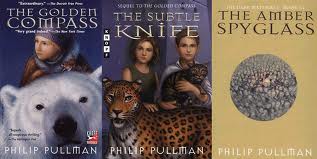
If you're desperate for more, may I suggest a return to the ultimate YA trilogy, His Dark Materials by Phillip Pullman. The Golden Compass, The Subtle Knife and The Amber Spyglass tap into what I think is one of the most ubiquitous questions raised throughout YA lit; what would you do if you realized that your parents, your teachers, your culture, your world was oppressive and corrupt? Would you be brave enough to challenge the status quo, even if it meant sacrificing everything? Phillip Pullman's books are pure brain candy; he takes our instinctive emotional reaction to injustice and grounds it with real-world references and a per
vasive, positive message of humanism, critical thinking and scientific inquiry.
vasive, positive message of humanism, critical thinking and scientific inquiry.This genre has become a cultural force. Popular YA novels are transformed into movies, TV shows and graphic novels, and they thrive online. The majority of these books are so visual that they are easily branded and marketed, and it's difficult, when recalling your first read-through, to distinguish your own imagining of these fictional worlds from the inevitable celluloid versions. But I think there is another factor at work here: we just love these characters. They are hyper-real, beyond relatable, and they live in worlds where emotions are boiled down to their most pure and powerful essence.
What is your favorite YA book or series? Why do you think they're so affecting and addictive? Discuss!
Tags:
seija
Friday, July 30, 2010
What We Talk About When We Talk About Blogs
I thought it would be nice to offer a small roundup of the blog posts and online articles that had us all talking this week. We are pretty much blogosphere addicts here in the Kids Department, and with good reason. Why, it was just this time last year that we were all wrapped up in the Justine Larbalestier Liar cover controversy. Not to be missed (and an example of the power of the book blog community). But what was it this week?
1) Matthew and Laurie Amster-Burton alerted us to this hilarious and also sad (or angry-making?) post by Dan Gutman, author of a whole slew of beginning reader chapter books, on his personal experiences with angry letters. Don't miss the "Hit List" at the bottom, which shows the most frequently challenged books last year and why they were challenged.
2) Checking in on Debbie Reese's blog, I found her post with links to first Ellen Wittlinger's piece in the Horn Book and then Arthur A. Levine's post about her article. Wittlinger writes about the Lambda Literary Foundation's decision to change the parameters of their literary award so that it can only be won by GLBT-identified authors, as opposed to anyone who writes books that the committee feels reflect the GLBT experience (Wittlinger, a straight author who writes lots of books with gay characters, isn't happy). I have to say, reading the comments section of Arthur Levine's post is a fascinating way to spend 15 minutes.
3) And has everyone heard by now (thanks for that link in the last post, Kitri) about the class-action lawsuit against Apple's iPad? Because, to quote the lawsuit:
Please leave your article/post of the week in comments. We won't read them when we're supposed to be shelving, we promise.
-Anna, Kids Books
1) Matthew and Laurie Amster-Burton alerted us to this hilarious and also sad (or angry-making?) post by Dan Gutman, author of a whole slew of beginning reader chapter books, on his personal experiences with angry letters. Don't miss the "Hit List" at the bottom, which shows the most frequently challenged books last year and why they were challenged.
2) Checking in on Debbie Reese's blog, I found her post with links to first Ellen Wittlinger's piece in the Horn Book and then Arthur A. Levine's post about her article. Wittlinger writes about the Lambda Literary Foundation's decision to change the parameters of their literary award so that it can only be won by GLBT-identified authors, as opposed to anyone who writes books that the committee feels reflect the GLBT experience (Wittlinger, a straight author who writes lots of books with gay characters, isn't happy). I have to say, reading the comments section of Arthur Levine's post is a fascinating way to spend 15 minutes.
3) And has everyone heard by now (thanks for that link in the last post, Kitri) about the class-action lawsuit against Apple's iPad? Because, to quote the lawsuit:
Indeed, according to the www.apple.com website, "[r]eading on iPad is just like reading a book." However, contrary to this promise, using the iPad is not "just like reading a book" at all since books do not close when the reader is enjoying them in the sunlight or in other normal environmental environments. This promise, like other portions of APPLE's marketing material for the iPad, is false.Hmmmmm...
Please leave your article/post of the week in comments. We won't read them when we're supposed to be shelving, we promise.
-Anna, Kids Books
Tuesday, July 27, 2010
Bookstore Evangelism?
Pam's post about Amazon got me thinking (and all of us talking, again) about a delicate issue: how can we praise and promote the unique and treasured thing that is the indie bookstore without taking a jab at our competitors? It's not always an easy conversation to have- we never want to hurt feelings, and I have no interest in trash talking. Even so, it's a conversation that comes up with some frequency. Whether it's someone asking what, exactly, “indie” means, or an offhand comment about the difference between shopping here and shopping elsewhere, I do want to talk about it. I believe, strongly, in what we do. And I don't mind telling people why.
This particular bookstore has been around for 110 years, and the collective knowledge floating inside this one building astounds me. I'm constantly impressed by the vastness and depth of information packed into the gray matter of my colleagues- when I'm looking for something obscure or vaguely defined, and someone says, “Go ask so-and-so, she's the gardening (or literary fiction, or history, or eastern religion, etc) expert,” I'm rarely disappointed and often delighted. The physicality is also important to me. Yes, I like the smell of books, and even more I like the walls of books, the surrounded feeling of being “in the stacks.” I like the lines of spines and artful covers faced out. I like to walk over to a shelf to put a book away, or find another one, and have coworkers find me, fifteen minutes later, sitting on the floor grinning silly like a kid. “You guys! Did you know that...” I like that a good bookstore is like a church of books- you can feel the reverence with which thousands of hungry eyes have passed over these shelves. People find salvation in books, and they do it here, all the time. I see it; I talk to them. The book love is palpable, and it makes it feel like a place not only book lovers, but books want to be. Like if you saw a stray book on the street, this is what a Good Home would look like to them, and if you brought them inside, they would wag their tail, find their place in the alphabet, and curl up to wait for just the right person.
There are political and ethical reasons for shopping with local businesses (which the previous post eloquently enumerated), and that's important to me, especially when it comes to the accessibility and diversity of art and information, which is what books are. But in the ideal indies-are-great conversation, I'd like to think we can emphasize what is truly singular about our store (and great independent bookstores in general) without landing too ungracefully on the implied corollary that those things are missing elsewhere. Regardless of what other options are out there, I have a lot to say about us. Because we have something special. Something I hope is irreplaceable, because a world without indie bookstores isn't the one I want for myself, or my future kids (which are a really long way off, so relax, Mom). So I guess I'm just going to have to keep talking about it.
--Anna, Kids Books
This particular bookstore has been around for 110 years, and the collective knowledge floating inside this one building astounds me. I'm constantly impressed by the vastness and depth of information packed into the gray matter of my colleagues- when I'm looking for something obscure or vaguely defined, and someone says, “Go ask so-and-so, she's the gardening (or literary fiction, or history, or eastern religion, etc) expert,” I'm rarely disappointed and often delighted. The physicality is also important to me. Yes, I like the smell of books, and even more I like the walls of books, the surrounded feeling of being “in the stacks.” I like the lines of spines and artful covers faced out. I like to walk over to a shelf to put a book away, or find another one, and have coworkers find me, fifteen minutes later, sitting on the floor grinning silly like a kid. “You guys! Did you know that...” I like that a good bookstore is like a church of books- you can feel the reverence with which thousands of hungry eyes have passed over these shelves. People find salvation in books, and they do it here, all the time. I see it; I talk to them. The book love is palpable, and it makes it feel like a place not only book lovers, but books want to be. Like if you saw a stray book on the street, this is what a Good Home would look like to them, and if you brought them inside, they would wag their tail, find their place in the alphabet, and curl up to wait for just the right person.
There are political and ethical reasons for shopping with local businesses (which the previous post eloquently enumerated), and that's important to me, especially when it comes to the accessibility and diversity of art and information, which is what books are. But in the ideal indies-are-great conversation, I'd like to think we can emphasize what is truly singular about our store (and great independent bookstores in general) without landing too ungracefully on the implied corollary that those things are missing elsewhere. Regardless of what other options are out there, I have a lot to say about us. Because we have something special. Something I hope is irreplaceable, because a world without indie bookstores isn't the one I want for myself, or my future kids (which are a really long way off, so relax, Mom). So I guess I'm just going to have to keep talking about it.
--Anna, Kids Books
Tags:
Anna,
independent bookstores
Thursday, July 22, 2010
Ivan Doig
A classic came into our store the other day. No, it wasn't published by Penguin and it wasn't an beloved used copy of Great Expectations. It was Ivan Doig.
There is no better reminder of the heart & soul of fiction writing than a man who writes his novels in longhand, reads them aloud with passion and character, builds relationships with the bookstores who sell his book and continues to draw captivated crowds and dedicated fans.
Thanks for a great event, Ivan!
Wednesday, July 21, 2010
PICTURE BOOK ART! YAY!

Y'all know how much I love picture book art, right? Well, since you probably can't make it to Massachusetts to go to that picture book museum this weekend, we're going to bring a picture book art gallery right here to the store! This Saturday & Sunday, July 24th & 25th, the U District store is hosting a gallery event with Picture Book Originals. We'll have original artwork and giclee prints available to purchase from some of the top-of-the-heap children's book artists: Rosemary Wells, Jez Alborough, Peter Reynolds, and more. We'll have the artists' books in stock as well, so stop by the second floor to check out their work and pick up a print to match your favorite book. We cannot wait to welcome you to our mini-gallery for the weekend.
P.S. Stop by the Kids Desk anytime this week to see a big print of Rosemary Wells's Yoko- adorable!
-Anna, Kids Books
Tags:
Anna,
picture book art
Subscribe to:
Posts (Atom)