
Passed away today.
On Charlie Rose, after his book Terrorist was published:
Here's a quote from the interview I quite like. He and Charlie are discussing the use of Arabic in the book:
"There's a certain mystery to a language you don't know, a certain beauty even—I don't know. Maybe it was a bad idea."
That post em-dash stuff was just sort of thrown in there. I love the fact that Updike happily admits to his own authorial fallibility there. "What the heck do I know? I'm just John Updike."
When an author dies, many readers—possibly out of a feeling of guilt—decide the time is right to familiarize or re-familiarize themselves with that author's work. I would like to suggest that readers who feel like they would like to become better acquainted with Updike's work also consider reading Nicholson Baker's remarkable book on Updike and his influence on Baker, U and I.
Tuesday, January 27, 2009


Thursday, January 22, 2009
Our Little Love Peddler


And don't forget books! How to Talk to Girls, by nine year old Alec Greven, from Collins, is just full of the kind of advice only a man of his years and experience could have to give. The Art of Romance: Mills & Boon and Harlequin Cover Designs, by Joanna Bowring and Margaret O'Brien, from Prestel, is a fabulous, full-color romp through the glory days of the chaste booty lit. of an earlier era. Dating Makes You Want to Die, But You Have to Do It Anyway: Getting Through the Absurdity of Dating with Your Soul Intact, by Daniel Holloway and Dorothy Robinson, from Collins Living, may help you survive the Season of Passion. And finally, Six-Word Memoirs on Love & Heartbreak, by Writers Famous & Obscure, edited by Smith Magazine, from Harper Perennial, is full of six-word wisdom like this from Matt Ruff, "She knows what my Kryptonite is."
 So stop in and consult the Love Peddler. She's waiting to hook you up.
Wednesday, January 21, 2009
A Big Ol' Box o' Lincoln
 While this hardly mitigates the dustjacket design, seeing The Lincoln Anthology: Great Writers on His Life and Legacy from 1860 to Now, in a boxed set from Library of America, goes a long way to making me happier about trying to sell the book.
 I've been trying to get the two volumes of Speeches and Writings back into the store in time for the Bicentennial, but I hadn't had any luck. Now I understand why. Redesigned with red and blue covers, and boxed with the anthology, they make a handsome, if a little on-the-nose design for this bran new presentation.
The two volumes of Lincoln are about the best presentation of Lincoln's words I've ever seen. They are certainly the best and most attractive collections of Lincoln that I own.
At $99.95 the new set is expensive, but had I not already bought separately the three books in it, I would be saving my pennies to get this one some day soon, before it disappears.
Tuesday, January 20, 2009
Their Lincoln (and Ours)
 Eric Foner is exactly the kind of history professor from whom I wish I could take a class; erudite, serious and excited by his subject. Reading his books, particularly A Short History of Reconstruction and Forever Free: The Story of Emancipation and Reconstruction, I've become convinced that if there is anyone who can teach me what it meant to be alive in America then, and what the lives of Americans then might and ought to mean to us now, it is Eric Foner.

His book The Story of American Freedom is one of those titles I have been pressing into the willing and reluctant hands of customers and coworkers since it's original publication. I know the title sounds like one of those well intentioned freshman Seminars, taught in an anonymous, drafty lecture hall by some dessicated old party with a slide projector, and actually conducted by weary TAs roaming the aisles with dusty pages of "supplemental readings," but you must trust me when I tell you, it is actually one of the most breathtakingly wide-ranging and scintillating acts of American intellectual history I've ever read. Reading Foner as he traces the progression of "freedom" and "liberty" through our history, is not unlike spending time, at least as I imagine it, in the personal library of a great bibliophile and conversationalist who darts from his chair every few minutes to produce the exact text he's been quoting from memory, just to show you yet another surprising instance of our mania for, and wildly contradictory usage of, the great watch-words and shibboleths of representative democracy. It is the author's enthusiasm, as well as his scholarship, that makes him such good company.

Now, for the Lincoln Bicentennial, Eric Foner has edited a new collection of popular essays from noted scholars -- no mean trick in my experience as a reader of history -- on subjects ranging from his own thoughtful consideration of the embarrassing topic of "Lincoln and Colonization," to James M. McPherson's brief summation of "A. Lincoln, Commander in Chief" (which I highly recommend if you don't intend to read McPherson's recent full-length treatment of the subject, reviewed in an earlier posting here.) Foner's new book is called Our Lincoln: New Perspectives on Lincoln and His World, from W. W. Norton. In addition to Harold Holzer on Lincoln and art, and Mark E. Neely, Jr. on Lincoln and the Constitution, there are names less familiar to me and essays I was surprised to find myself enjoying thoroughly. David W. Blight, for example, I did not know. The very title of his essay, "The Theft of Lincoln in Scholarship, Politics and Public Memory," made me jumpy. That word "theft" has the spin to it of literary-theory and "historiology" --id est gab about rather than history written. But it actually proved to be one of my favorites in the collection; taking on the Lincoln pietists, bully patriots, politicians and revisionists all at a go! Now I must find Blight's latest book, A Slave No More; Two Men Who Escaped to Freedom, Including Their Narratives of Emancipation, from 2007, and put my embarrassing suspicions to rest.
I would encourage anyone interested in contemporary Lincoln scholarship to seek out this new collection, without a worry that the common reader will find anything therein but consistently well written, thoughtful, and "theory"-free American history of the best kind. (Foucault, for example, is blessedly absent entirely from the index. Can I get an "Amen?")
A Room of Their Own
If you've ever wondered about the rooms where writers go to work, check out this feature at The Guardian's website. The latest shows novelist Sebastian Faulks' office, complete with his cameo of Tolstoy.
Monday, January 19, 2009
Holzer & Company
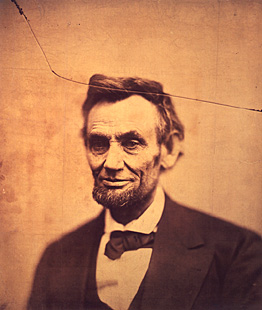
In an earlier post, I already expressed my deep displeasure at just how awful the design of the dustjacket is. But, as I suspected I would, I've now become convinced by the contents that I shall have to have my own copy of Harold Holzer's new Library of America title, The Lincoln Anthology: Great Writers on His Life and Legacy from 1860 to Now. It is a rich and varied collection -- boy howdy and how.
Where else, exactly, can one find, between two covers, H. L. Mencken's sobering and mirthful essay from his Prejudices: Third Series, in which one finds the "Lincoln legend" so perfectly described as "... a sort of amalgam of John Wesley and the Holy Ghost," and also Langston Hughes' poem "Lincoln Monument: Washington?" Holzer has bundled together a wonderfully eclectic collection of people, from contemporaries to biographers, from cartoonists to politicians; from H. G. Wells to Dale Carnegie (!), from Emerson to E. L. Doctorow, and on and on.
Better yet, Harold Holzer has written a brief, often quite pithy preface for each entry. This from the introduction to Woodrow Wilson's contribution: "Left entirely unmentioned in Wilson's eloquent address were slavery and emancipation -- omissions that were not surprising in light of Wilson's segregation of black government employees and his effusive praise for D. W. Griffith's racist screen epic The Birth of a Nation."

Unlike some earlier anthologies from the Library of America, and here I'm thinking specially of their truly weird collection of Sermons, this volume, in the very capable hands of Harold Holzer, manages to present the familiar and the unknown -- at least to me -- in an entirely satisfying and endlessly surprising way.
As tributes go, this is one of the best, if not the best to date on the occasion of the Bicentennial.
Sunday, January 18, 2009
Further Thoughts on Stacey's Bookstore and the Passing of the Independents
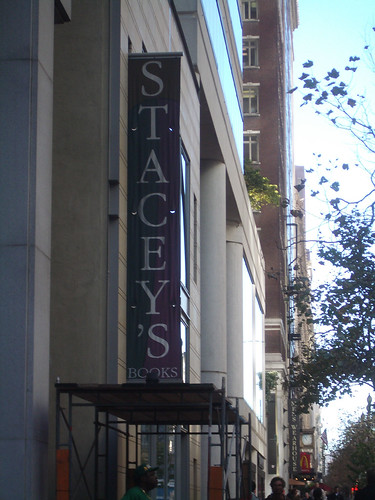 Since my first posting on the sad news that Stacey's Bookstore in San Francisco had announced it will be closing in March after 85 years in San Francisco, I've been following the story online and through friends in San Francisco. On Facebook I was encouraged to discover a "grassroots" effort organizing to "Save Stacey's Bookstore." I've also heard from many people, online and off, expressing shock and dismay at the news. On behalf of Independent Booksellers everywhere, let me extend my thanks to all the good people out there who care about where they buy their books and from whom. What we do, and the opportunity to do it, depends on just such thoughtful, community-minded patrons. We have always been, and continue to be grateful for your support, and your business. And if I may still presume to speak for the booksellers at Stacey's, I'm sure they are just as grateful for the many new and familiar voices joining the chorus now rising to try to save that venerable bookstore.
In my reading online, I have also discovered just how many people there are out there who seem to misunderstand the nature of just what it is we do; assuming, for example, that the prices of the books we sell are a matter of choice for independent retailers, that discounts to customers and variety of selection are dictated exclusively, or even primarily by considerations of profit and promotion, and that even the continued viability of independent bookselling is ultimately more a matter of management and competition than it is a matter of cultural or community significance. Let me try, in my own unbusinesslike way, to address some of these points, as briefly and as well as I can in this space.
Without becoming too mired in the jargon of bookselling and publishing, let me just begin by suggesting that the whole business of books is, has always been, and Gods willing, will always be an irrational, impractical and frankly foolhardy enterprise. The suggestion that anyone can, or has, or ought to make a proper, well organized, smooth-running machine of Market Capitalism out of writing, printing, publishing or selling books, is as familiar, and touching to booksellers, however humble, as it is to anyone else who may have spent their lives in the service of books. Many a better man and woman of business than me has been broken on that wheel. Business, and in particular the business of books, has seen many an entrepreneur rise and fall in the tide of print. Many have made fortunes, or at least reputations as innovators and great capitalists from books, from the man who opened bookstalls in Victorian train-stations, to the popularizer of classics in paperback, to Jeff Bezos of Amazon.com. Each is to be well remembered and applauded for their contributions to the culture as well as for their business acumen and willingness to risk their own and other people's money in such, for the time, questionably profitable gambles. But for every innovator in publishing and selling, there have always been hundreds or possibly even thousands of less daring souls, readers and retailers, bibliophiles and buyers and tradesmen more like... well, me.
We no more set the price of a hardcover from Random House than we determine the value of Amazon.com stock. And we live, as do the independent publishers, the freelance writers, editors and translators, and, it would seem, the readers and collectors of less established, or well remembered authors, on the narrow margins of solvency, not because we are reckless or stupid or undisciplined, but because what we love is the company of books more perhaps than we do the business of books, and will, it seems, often as not, sacrifice, to our own ultimate ruin perhaps, the latter to secure the former.
A short discounted title from an academic press on an obscure subject? But surely, Stacey's must have at least a copy of such a book on the shelf when, and if, the right customer comes in to find just such a book? Else how will the reader know he or she needs it? Not one, or even a few of the newest or the best books on Lincoln for the University Book Store, but all the titles we can get that might be worth having when we set up a display table to celebrate the Bicentennial of his birthday, else are we not doing a disservice to our customers and to the writers and scholars who have labored to preserve our history and his memory?
And if we can not discount the New York Times Bestsellers list as a result, or choose to promote our own selection instead... And if we can not sell every bestselling new children's title at prices to compete with Costco, but choose to celebrate the PNBA Lifetime Achievement Award winner Alexandra Day by carrying every available title in multiple copies instead...
That is the value that is lost in the passing of Stacey's. Those who criticize or sneer at the incompetence of the independent bookstore in the face of the more elegant and profitable business model of the chain store, or whose purchasing is dictated by the automated suggestions provided by the wizardry of online marketing, rather miss the point. We do not do this, and Stacey's did not do what they did for 85 years, because we, or they, hoped one day to be rich as the result of of our labour. We, and they, did and do consider ourselves rich in the books and authors we've known, the customers we've met, the generations whose reading and opinions we've cultivated and cared about, in the culture we've supported and sold. We simple booksellers, in all our enthusiasm and old-fashioned amateurism, have done what we do because we believe, ultimately, more in the supremacy of the word than the dollar.
And if that sounds too grand for such as us, perhaps it is. We are ultimately peddlers, not artists. But do please at least give us this: should Stacey's, and all like it, be allowed to go, do you really think the world will be a more art-full, or a better place? Or will it be, simply, a more profitable and convenient market? Nothing wrong with that, of course. As you like it.
Meanwhile, my thoughts and my heart go to Stacey's and all who still love the books, and the booksellers therein.
Saturday, January 17, 2009
Dog of the Week
 This is Sydney. She genuinely enjoyed sniffing the store thoroughly. She also seemed to enjoy her cookie, once it had been thoroughly sniffed. She was about as friendly as a dog can possibly be without actually bursting.
Good Dog, Sydney!
Subscribe to:
Posts (Atom)


 Posts


